
Did we adapt to cooked food, or is that idea—ahem—half-baked?
In part 1 of this “optimal human diet” series, I mentioned that there is no single, exact diet that will deliver perfect health for everyone. We’re tough cookies, us humans—and we only made it as far as we did by adapting to whatever happened to land on our evolutionary dinner plates. Mastodon meat, sweet little figs, plant roots—we made food of it all.
Even so, there’s a notion in the raw food world that we’re still best-suited for the type of diet we ate back in the good ol’ days. You know, before we exited the tropics, conquered all corners of the planet, and invented the deep-fried Krispy Kreme (which surely triggered the downfall of humanity). Maybe you’ve heard claims that we haven’t adapted to cooked food at all, that we’re designed to be vegan or vegetarian, and that our digestive systems still look like those of other fruit-munchin’, leaf-chompin’ primates.
But do those beliefs hold up to reality? Let’s take a look.
Digestive anatomy
There’s no doubt that we have plenty of anatomical similarities with other primates. We do share a good chunk of their genes, after all—especially chimpanzees, bonobos, and orangutans. In fact, some researchers have argued that chimpanzees should be reclassified under the same Homo genus as humans because we’re so similar, although this is pretty controversial and it’s been challenged by more recent research.
All in all, humans have the same general digestive structure as apes: a single-compartment stomach, a small intestine, a cecum and appendix, and a colon. Pretty simple.
But the devil is in the details, as they say. When you look closer, our digestive tracts have some major differences compared to other primates—differences that pose dietary consequences. The most significant is the size of our small intestine versus our colon. In chimpanzees, gorillas, and orangutans, the colon is about two to three times the size of the small intestine. But in humans, those figures are reversed: the small intestine dominates, clocking in at over twice the size of the colon.
A visual representation for your viewing pleasure (humans are the striped bar):

- Taken from “Nutritional Characteristics of Wild Primate Foods” by Katharine Milton, Journal of Nutrition, 1999
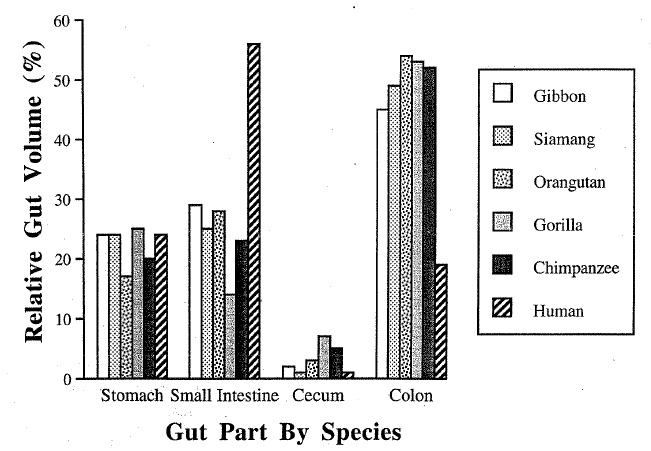
As you can see, there’s not much difference in relative stomach volume—but other primates have a whole lotta’ colon, and we’ve got a whole lotta’ small intestine.
So what does that mean?
In simple terms, a big colon is good for handling “low-quality” foods like tough leaves, stems, and fibrous fruits—things that require a lot of digestive work to break down. Primates that eat boatloads of greens, like gorillas, have a whole army of microbes in their colon that digest cellulose and convert it into an energy source. That’s a process called “hind-gut fermentation.” Humans aren’t so lucky; we can digest some forms of fiber, but much of it passes right through us without delivering nutritional value. Our colons aren’t big enough to host enough little organisms to ferment things as effectively as other primates do.
On the flip side, a big small intestine (is that an oxymoron?) is perfect for digesting high-quality foods that are dense, smaller in volume, and easy to break down. That includes soft fruits, animal foods, cooked foods, tender leaves, and perhaps items that have been pre-processed through chopping or grinding. Even our modern-day blended and juiced foods make our small intestines happy, because that pre-processing translates to less digestive work.
In other words, humans are adapted to a softer, more compact diet than other primates. Our bodies have moved away from extremely high-fiber cuisines and are better suited for foods that require less digestive effort.
What caused the change in colon and intestinal size?
This is one of those mysteries that researchers like to argue about, but no one has a definite answer for. What we do know is that the change was sparked by a shift to more energy-concentrated diets. It could have been:
- A higher reliance on meat, fish, and other energy-dense animal foods
- The advent of cooking and the subsequent “shrinking” of our food size
- Consumption of more nutrient- and calorie-dense plant foods
- The invention of tools for chopping, grinding, and other forms of processing plant matter
More likely than not, it was one (or both) of the first two. Our shrinking colon size is pretty clear evidence that our bodies started adapting to the energy-dense structure of cooked food and meat, since we no longer had to rely primarily on bulky, super-fibrous plant foods.
Does that mean we should all be cooked omnivores?
Even though our bodies have grown accustomed to denser diets than our primate friends, that doesn’t mean cooked food is mandatory or that veganism is impossible. What it does mean is that the most successful human diets are going to have some form of concentrated nutrition. On a completely raw vegan diet, the options are very sweet or fatty fruits, nuts, sprouted grains, coconut, seeds, juices, or blended foods. Although I don’t recommend a lot of gourmet-style raw meals and dehydrated snacks in general, those fit in here as well. On a raw non-vegan diet, those dense items could be animal products like raw dairy, fish, eggs, honey, or raw meat. On a high-raw diet, you could opt for steamed root vegetables, grains, cooked legumes, and so forth.
Basically, what we can’t do is live off of leaves and occasional fibrous fruit for extended periods of time like most primates can. Thanks to our dwarfed colons, we would starve.
Shouldn’t we be vegan because meat causes disease?
I’ve said it before and I’ll say it again: veganism is an ethical choice, not a dietary ideal. Today, we know enough about nutrition to plan or supplement a vegan diet to avoid deficiency, but eschewing all animal products won’t necessarily make you healthier than eating a diet containing a portion of high-quality animal foods.
Part of the reason animal foods get a bad rap these days is because of our farming practices. Agricultural products like dairy, farmed meat, and eggs from grain-fed chickens are a far cry from anything we encountered in the 2 million years prior to agriculture. And the state modern animal products (along with the often-horrific way farm animals are treated) is particularly disconcerting. Along with carrying high levels of growth hormones, pesticide residue, and other harmful substances, grain-fed animal products have a far different nutritional composition than wild animals eating their natural diets. And that spells trouble for the humans who eat such foods.
For instance, grain-fed cattle is significantly lower in omega-3 fatty acids and higher in omega-6 fatty acids than grass-fed cattle—an imbalanced ratio that numerous studies have linked to cardiovascular disease, cancer, and autoimmune diseases.

From G.J. Miller, "Lipids in Wild Ruminant Animals and Steers," published in the Journal of Food Quality, 9:331-343, 1986; image courtesy of EatWild.com
Total fat composition is also much different between commercial, grain-fed meat and wild game:

For more information on the differences between pastured animal products and commercial, grain-fed animal products, visit the Eat Wild site.
It’s certainly no surprise we find high rates of disease linked to these foods. Although animal products and byproducts have been components of our diets for quite a while, “franken-meats” pumped full of hormones and antibiotics are the equivalent of space aliens in our digestive systems. They just don’t belong there. At all.
A word on cooking
Although we have adapted to the energy density of cooked food, we haven’t necessarily adapted to all the new substances cooking produces. Charred meat, for instance, contains compounds called heterocyclic amines (HCAs) known to contribute to cancer in humans. Acrylamide, another human carcinogen, occurs when many starch-based foods are heated. Maillard molecules and glycotoxins crop up in browned foods, and these suckers contribute to inflammation and other unpleasant conditions (research here is still in its infancy). And eating high-temperature cooked food may also accelerate aging due to advanced glycation end products.
In other words, there’s good reason to include plenty of fresh, raw foods in your diet even if you don’t jump on the 100% raw bandwagon. And high-temperature cooking seems to stir up all sorts of trouble, so if you prefer to eat some cooked food, gentle methods like steaming are the safest way to go.
In conclusion…
There might not be a single optimal diet for humans, but health-producing cuisines—especially ones with a reputation for healing ailments and reversing chronic conditions—typically have a few things in common.
- Elimination of refined sugar, high fructose corn syrup, and other nutritionally-devoid sweeteners
- Avoidance of man-made ingredients and fake foods—such as artificial sweeteners, soy-based meat replacements, chemical additives, nitrites, preservatives, artificial flavors, dyes, margarine, and hydrogenated fats
- The inclusion of mineral-rich foods (dark greens, seaweed, animal organs, green juices, or produce grown in well-mineralized soil)
- No pasteurized, homogenized cow dairy
- An emphasis on eating foods in their whole state
- An emphasis on some or all pre-agricultural foods (fruit, vegetables, meat, fish, nuts, seeds) rather than post-agricultural foods (grains, potatoes, dairy, vegetable oils)
- A large portion of fresh, raw foods and/or “living” foods (kombucha, fermented vegetables, kefir)
- High nutrient density
If you eat a diet that fits the above description, raw or otherwise, you’re probably well on your way to staying healthy. Even though I prefer a completely raw diet for the level of clarity and surging energy it brings, I have no reason to think that a 100% raw diet will extend a human’s lifespan or offer more immunity to disease than a mostly raw diet with well-planned cooked foods.
But regardless of what you put in your mouth, remember that an optimal diet is one you can sustain—and that doesn’t knock your whole life off kilter by making you socially, mentally, or emotionally imbalanced. Diet is only one component of health and should never become the driving force in your life.
 Denise Minger
Yeah i totally agree with you , i was thinking about this the other day and got to similar conclucions ,there are many different health diets that seem to work for different people , raw, paleo, etc.
But there were some common things with all this diets, for example
the use of natural complete foods
the absolute hate and allergic reactions to mcdonalds and highly procesed foods(american diet, or shall i say, global diet)
there is a book you may find interesting, its called “the spartan health regime” i know, the name is utterly ridiculous, and if you read it you will find that sometimes the guy sounds like the lost son of george patton but he has some intereting things, his approach may be considered similar to paleo,(even before paleo diet was widely known) but some of the differences are the extremly high consmption of raw fruit, no matter how sweet, sounds familiar?(yeah baby, mango mango mango)
Anyway, if you are interested in knowing more about it , let me know.
Wow, thanks for the book recommendation! It sounds like something I’ll definitely want to read. Is it available online anywhere, or only in print?
its an ebook, only find it online
bye bye
there is a very interesting subject in raw diet , “energy”.
im an extremly low energy kind of guy , from always i remember not having energy to do stuff and and getting tired very easily , i think its related to health issues , dont know, i even sleep between 9 and 11 hours .
it is possible to improve your health with many different diets, but what seems to be the most seductive part of raw is the massive amount of energy you can get (and having a demigods like glowing skin isnt bad at all jeje)
what can be under discution is the porcentage of raw you need to enjoy this benefits , some of the most hardcore raw foodist say that you only get the best with 100% raw, some say this is overreacting and you only need 80% some others even say that thats bulsh%& and the reality is that with 50%(mostly fruits) you will have all you need
what is your opinion?
i think this would make an interesting post
(by the by denise did you get my email?)
I’ve learned that we tend to have less energy when our insulin levels are high.
To keep our insulin low, it could be helpful to restrict the amount of carbohydrates we eat. While doing that it’s really important make sure to get enough calories to burn as fuel, by increasing the amount of fat we eat.
We also need enough proteins and essential fatty acids as building blocks for the hormones and neurotransmitters like adrenaline and dopamine that make us feel good and energized.
I feel that, for me, eating a high fat, moderate protein, low carbohydrate diet works best to optimize both mental and physical energy.
I do think it’s important to eat something raw regularly.
I start every meal with some raw juicy plants that are low in digestible carbohydrates, like leafy greens, radish or cucumber.
Followed by a complete protein source from the animal kingdom, like wild caught fish or grass fed meat. To make the meal completely satisfying, enough fat or oil is added to meet my calorie requirement.
An example of what I could eat in one day with four meals:
1. Four radishes. Six small eggs with 25 grams of olive oil.
2. Lettuce and dandelion. 250 grams of fish with 50 grams of cultured butter.
3. Cucumber. Four large eggs with 25 grams of olive oil.
4. Endive. 100 grams full fat yogurt with 10 grams shredded coconut and a tablespoon of spirulina. 50 grams of butter.
Preparation:
Egg whites were baked, yolks kept raw and added back after whites were done.
Fish baked so that inside was a bit raw. Sometimes not baked at all but warmed to body temperature.
While I support and practice paleolithic eating and living, I don’t belief in the Darwinian theory of evolution.
While I’m skeptical of the Bible or any religious document, I do belief the different species were created by an intelligence beyond our physical dimensions.
I’ve heard that to keep insulin levels low you have to restrict the fat intake.. At least if you’re going to be eating a lot of [fruits] carbohydrates. I am not quite sure if humans were designed to eat processed foods – like oils.. maybe we were. However, if you want to eat fruits (like I do), it’s best to just cut oils and excess fat out of your ‘diet’. Ha, just realized that no matter what diet we still are die-et-ing! 🙂 Die-ing..get it? Anyways – as fruit is the best source of energy and the most easily digested – it’s the best fuel and doesn’t require energy to digest.. giving you more energy to do your daily tasks. Plus, you don’t have to cook them.. prepare them.. and you can eat alot more of them! (I likes to eat. ^__^) I don’t know who told you about the need to eat to burn calories for energy.. seems quite the opposite actually. You need food to sustain you and provide nutrition for your body to function well. Calories don’t give you fuel, [fruit] glucose does! As a protien-type however, I myself need more protien and calories during the winter as fair-skinned people make heat this way, carb-types don’t (people who came from places near the equator, darker skin). It’s smart to look at what worked for our own ancestors.. and what didn’t, and research the science behind it. I might try eating fish like you do, and eggs, I prefer not to cook that much, though. If you’re interested in the history of mankind.. I recommend reading some articles from the Desteni website. If you dare. 😉 Take care!
Just a quick question, from what you know; what do you think would be an optimal diet for one who is mixed race?
For example, one who has native 50% native South American ancestors, 25% English & 25% Spanish (White european)
Hi
Great blog
Raw is good for sure. However we have examples of people who ate mostly cooked foods. Native American Indians for example, their diet was based mainly on cooked meat, fat and maize. Saying or suggesting that row foods are healthier than cooked ones is simply wrong.
The key to healthy cooked meats is proper way of cooking. Cooked meat and fat might be much healthier than raw vegetables and fruits. Modern fruits are loaded with sugars. We can say that we are well prepared for ingestion of cooked meats and fats and not so well for ingestion of sweet fruits.
Sweet fruits and colourful vegetables are modern invention. I’m not saying they are unhealthy, I’m saying only they are short in many necessary for human health nutrients.
In long term run I think that high quality cooked meat with cooked fat will be better for most of us than raw vegetables and raw fruits.
There is raw meat diet of course and this is completely different story.
My diet is a mix of raw and cooked meat, raw and cooked eggs and raw and cooked vegetables in small amounts.
I have some chesses and berries time to time, mostly eat butter, goose fat, cream and beef suet.
Probably you know this article, here is the link http://www.manataka.org/page1852.html
Have a good day
Andrew
A good point to make here is that not only did meso- and North-American natives cook the maize, they processed it with a highly alkali ash solution to turn it into nixtamal (aka hominy). This process reduces the amount of zein (the corn “gluten”), enhances niacin (which prevents pellagra), destroys phytates (which chellate minerals), enhances digestibility (the amino acid balance is altered), and, depending on the type of ash or lime used, increases the calcium and/or potassium content of the corn.
When maize cultivation spread around the globe around 1900, populations who depended upon it who did not nixtamalize suffered pellagra outbreaks, including Northern Italy, South Africa, and the American South. (Ironically, Quaker brand grits, eaten throughout the South today, are nixtamalized. The pellagra victims were eating bread made from corn meal, which is unprocessed aside from milling.)
I think it’s important to note how traditional cultures subsist on dairy, potatoes, and grains with little to no chronic disease. The Masai, for example, have almost no heart disease or cancer, yet get the vast majority of calories from cow blood, milk, and meat.
As long as populations prepare whole grains properly through soaking, fermentation, or sprouting, they tend to do just fine, assuming an otherwise traditional diet. Potatoes are quite nutritious; I think what’s important when it comes to starchy foods is *moderation.*
That said, I do agree with your villifying vegetable oils, heavily processed dairy, and other industrial foods.
I was reading about potato toxins and apparently roasting them destroys the toxin, rendering them edible. (You can eat raw potato, but if they’ve been exposed to sunlight, you might want to go for the inside unless you are angling for a date with a Poison Control officer.) Boiling is not so effective, which is probably why potatoes were peeled before boiling and mashed potatoes and potato salads did not have peel in them until more recently.
Weston Price studied Swiss peasants high in the Alps and found they ate a sort of sprouted rye bread. I believe this may be similar to the “special” rye which my German relatives used to buy imported at the holidays. It was dense, moist, and crumbled readily, unlike crusty bakery breads. (They also ate a lot of pastured butter and cream, which Price tested and found high in vitamins, which explained the good state of the children’s teeth.) It may be that we just are exposed to much higher amounts of the bad stuff in bread than people in the past, accelerating the destruction of our digestive systems, just as a celiac may become lactose intolerant, not on account of genetics, but because of degeneration of their digestive organs as the disease progresses.
Greeks in the classical era boiled their meat. The elites in their society also enjoyed good life expectancy. Grilling and charring meat may be a mistake…
Industrial frying seems to cause chemical changes in food. I read a little about it and don’t really understand, but it seems to change the nature of the starches. The industrial objective is to create a crunchier chip, but perhaps it becomes less digestible. My stomach will gladly eat fish or fries out of the fryolator, but fried “tortilla” chips* come right back up. Still learning…
*-Cannot actually get good info if these chips are made with masa or corn meal, except for Fritos. Fritos are made with wet masa, and I actually tolerate them well! (Also, some restaurants are now slipping wheat flour into their masa flour–WTF.)
Wow, very cool info 🙂 I will be roasting my potatoes from now on.. and boiling my meat! Thanks duude.
i think a tastier correlate of “boiling” might be “stewing” (e.g., in a salsa verde)
Hey Denise,
have you ever heard of the expensive tissue hypothesis? It’s a theory that aims to explain (rather convincingly, I think) the differences in brain size between humans and other primates. Specifically how, due to Kleiber’s law, a bigger brain with its higher energy consumption must come at the cost of a reduction in organ mass elsewhere in the body. In our case that meant a smaller gut which in turn required a more nutrient dense diet (i.e. more meat).
A theory which will neatly explain not just the small intestine-colon differences between humans and our close ape relatives, but other gross differences in morphology is the Aquatic Ape Theory, favoured by no less than David Attenborough himself: https://www.theguardian.com/science/2013/apr/27/aquatic-ape-theory-primate-evolution
Is kombucha really healthy?
depending on how you make it, it’s either sweet (sugary), alcoholic, or vinegar with a base of tea instead of fruit juice. i haven’t seen anything suggesting that thet fermentation process is any different from traditional soft drink, wine/mead alcohol and vinegar production apart from the starting ingredients.
Scientific American did a great article about food, nutrition and evolution a while back that covered the “expensive tissue” issue and a few other things. Here is a link to the article.
Click to access Scientific_American_Special_Online_Issue-2004-01-11_Diet_And_Health.pdf
http://www.second-opinions.co.uk/carn_herb_comparison.html
I think there is a clue in the fact that the hind-gut fermentation process in the primates and the fermentation in the stomaches of the other vegetarian animals yeild a net energy intake of ~80% fat for the animal. Even thought the animal is eating carbohydrate the bacterial fermentation process turns the carbs into fat, so the animals are burning fat as opposed to glucose as an energy source.
Human digestion does this a little bit, too.
Thank you for this excellent blog.
wholefoods,unprocessed,organic ,fruit and vegetables,sea vegies,nuts and seeds(ground finely so all nutrients possible are absorbed),being well hydrated,herbal teas,fish,eggs and some lean chicken,whole grains,(oats,brown rice,quinoa red and white yes technically a seed~)a good portion of raw food at every meal.THIS is the way of eating,that is allowing my poor little depleted body(from almost 7 years of raw vegan) to heal itself and hopefully fully regenerate.Oh and enjoying some pink himalayan salt,get those minerals in!
Thanks Denise an awesome well thought out article,as always 🙂
Nicely done. My one nit is that while we haven’t necessarily adapted to cooking, the opposite isn’t true. I don’t think there’s much actual evidence either way. “Charred meat, for instance, contains compounds called heterocyclic amines (HCAs) known to contribute to cancer in humans” seems like a stretch. Breathing contributes to cancer in humans as well, the question is what is my relative risk from eating charred meat vs. raw?
At any rate, cooking has been around long enough that any significant effect on reproductive fitness should have been seen. That humans continued cooking there food indicates that cooking has somewhere between a negligible effect (positive or negative) to a positive effect large enough to force some selection. And SOMETHING made people keep on cooking (of course something makes people eat bagels and jelly – that doesn’t mean it’s a healthy practice).
Note that this is all in regards to reproductive fitness. If barbecuing your wooly mammoth led to cancer after the reproductive years had passed, then there would be no selection effect.
I’m not looking to get into a debate on raw vs. cooked. I don’t feel like there’s much evidence either way.
Good point about reproductive fitness. And there it seems cooking meat by whatever method for the last 200000 years has it over eating grains for 10000 or many fewer. Celiac disease in women causes infertility. (I guess that would select pretty strongly for a) early menarche and b) gluten tolerance in early-adopter-of-wheat/barley populations. Less luck for those groups who started on wheat much later.)
OTOH, grains == civilization. And you’re prying my mac mini out of my cold, dead hands. 😀
Another excellent post, Denise.
Have you read “Good Calories, Bad Calories” by Gary Taubes? Your points regarding the avoidance of dietary toxins are well taken. I think the availability of refined, concentrated carbohydrates may be the single most significant health threat facing modern humans. The current obesity “epidemic” is cleary related to it and not much else, as are the downstream degenerative diseases associated with insulin resistance.
Sounds like you’re a Weston Price fanatic…. Hmmm reccomending Kombucha tea sounds like a good way to tax out the Adrenals. I say that stuff is no good.
Although I’m still not sure about the verdict of raw food and vegan vs. having some Animal protein in the diet, dont follow everything WPF says, they have an agenda too and they are quite vicious about it.
I just wanted to add: there’s a book you might want to read called “Catching Fire: How Cooking made us Human” by Richard Wrangham. He makes a strong case for the introduction of controlled fire and cooking into human history as far back as 2.0 to 1.75 million years ago, when Homo Erectus came on the scene. I’m an archaeologist who is interested in the palaeolithic, and his arguments are very very persuasive.
hi everyone, i work with a guy called tony wright he has published a book called “left in the dark” also has website http://www.leftinthedark.org.uk
heres the thing, i think all the data on gut size etc. etc. etc is good. but we have a perceptual problem in our left hemisphere which does not allow us to interpret the data properly. left hemisphere is dominant and confabulates a story from the data that is acceptable to itself. tony’s book explains all this and it would have a massive effect on your conclusions regarding diet etc. the human brain rapidly expanded, then stalled, and has been degrading ever since. hi octane, forest fruit diet fueled the expansion! (we did not need to ferment shoots and tough leaves. forest home dissappeared. (brain fuel with it) we had to eat anything to surveve. brain shrinks, and develops a negetive feed back loop. this affected everything and especially our brain, which developed a rather nasty left hemishere glitch (to say the least) thats where we are today. the left hemisphere is in charge and went on to build this insane and crazy world we parcially see (he, he) around us.
tony has joined the dots of well accepted scientific data accross all fields.
we are now talking and doing seminars to scientists and researchers around the world. many agree with the findings and the obvious conclusions of tony as outlined in the book. please get in touch, have a look at the site. the information and implications are truly paradime shifting and this actually is cuasality of our problem as a species, it is amazing. paul jackson (graphic design translation).
Oh my g**, are you serious? So we don’t know what we are doing? Logic is not logic? Nothing is as it seems! Nothing can be explained! Wow!
And yet we sent a manned rocket to the moon and back. Fueled by beef and bread, not forest fruits. Ye gods…
How many people have actually been to the moon, though — compared to the Average earth-dweller? I guess you can continue to eat your Dominoes- since they’re planning on opening a restaurant for all those who neglected to consider their health HERE on earth. 😛
Another interesting read. Thanks.
I curious where everyone stands on the issue of anti-nutrients; specifically lectins and the effects of “leaky gut syndrome” on overall health and the rise of autoimmune diseases and overall ill health?.
Perhaps we are all dancing around the same issue regardless of our personal nutritional beliefs(with the exception of the vegan zealots) in that there are simply some foods we just should limit or not eat due to the high level of antinutrients.
I agree with pretty much everything you’ve written in this post. Yet I noticed an evolution of your thought from part 1 to part 2 in this article which I thought was ironic. In part 1 you mention that we haven’t adapted to cooked foods, which seems to be true, yet people who are eating them are living longer than ever, although more elderly people are disease-ridden too so that’s not a strong argument. Also, you say we should be eating what other primates are eating in part 1 but seem to change your view on that based on the evidence. So I guess it’s really that you’ve come across new evidence that influenced what you wrote in part 2 rather than a change in your opinion on the matter. Since other primates eat only plants that wouldn’t work for us because although we’re similar to them, we have at least one major difference, which is a much bigger brain. This requires that we eat more energy dense food such as meat, fruit, and nuts, and a strong argument can be made that this is in fact why our gut became smaller than that of other primates, namely to more efficiently digest more nutrient dense foods in our diet. Besides these two points I think your analysis on the china study and diet and nutrition is eloquent, witty, logical, and enlightening. Many of the things you think and write in your posts are some of the same ideas I’ve thought and written about myself over the past few years, but without the chance to spread them, so I’m glad you’re able to. Finally, I recommend reading Deadly Harvest by Geoff Bond, it would back up every point you’ve made and explains so many things about how our ancestors lived, how they evolved, and how far from that and our optimal diet and lifestyle for health we’ve strayed from.
Other primates do not eat only plants. In fact, there have been a lot of papers lately about the economics of meat distribution and consumption in chimpanzee communities. (Gorillas, otoh, eat mainly cellulosic plant matter, and their guts reflect this–see the chart Denise provided, above.)
Google “bush babies”. Primates eating primates!
lol, so I have the habit of skimming articles, and occasionally I miss something. That was the case when I skimmed part 1, because I missed the paragraph right before the bullet points that basically said these aren’t your claims but rather the claims of vegans/vegetarians and you’ll be trying to find out whether there is evidence to support or refute them in part 2. So sorry for that. But after the part where I got mixed up, I still stand by the rest of my first comment, and that I think you’ve done a great job exposing some of the myths of the vegetarian diet and evolution.
rigorous-science-oriented blogger Dr KGH at paleonu.com claims that beef contains so little non-fully-saturated fatty acid, that the 3-versus-6 issue is moot…. for this one particular foodstuff.
That still leaves several other reasons to prefer “grass-fed” beef. I put the term in quotes because in the absence of enforced standards, the term has become advertising hype. Two supermarkets in this area feature it; neither of them can tell me if their product was 100% grass-fed throughout the whole lifetime of the animal. Which it needs to be for the benefits to truly exist.
“Pastured” is a particularly worse marketing-hype word. It denotes nothing in particular and proves nothing at all. No enforced standards by anyone anywhere.
Bovine ranching is a difficult business to begin with. It is not surprising that ranchers hesitate to do specific written labeling (= a promise) which puts them into legal jeopardy if weather/feed-price circumstances change….
Hey Denice
Another excellent point my wife (who’s an optometrist) made was that humans have stereoscopic vision (eyes in the front of their head) which only omnivores and carnivores have – it helps them hunt prey!
On the other hand herbivores have eyes on the sides of their head.
Sincerely
Amit
Random thoughts: I hope that the dangers of browned foods are, somehow, being exaggerated. Browned meat tastes so so so much better than, say steamed or boiled meat. Any benevolent deity would let me eat beef and lamb roasted with garlic.
I’m reading the Richard Wrangham book right now. Interesting, though your blog says many of the same things in less space. One thing I found interesting is that humans have very small mouths, relatively speaking, and eating leaves all day would be a most inefficient way to survive.
I’m glad you’re happy on raw. Raw foods give me enormous stomach pain and bloating/gas which interrupts my sleep. Still trying to figure out my ideal diet. (Already figured out wheat is out, also I can’t eat large quantities of unnixtamlized corn, ie corn meal, so no more arepas or corn bread for me (at least I have gorditas), and then there’s a possible celery-carrot allergy. CRY!!!)
Here is the case study on Kombucha linked earlier in comments:
http://is.gd/Z0cDLS ‘kombucha.pdf’
And it also mentions ‘Transaminitis has also been reported in a 53 year old male and a 83 year old male following daily ingestion of one half cup serving of Kombucha tea for 2 to 3 weeks. Liver enzymes returned to normal following cessation of tea consumption in both patients (4) More recently, Kombucha tea was implicated in the case of a patient with new onset anti-jo1antibody-positive myositis.(8)’
Corrected link: http://is.gd/L3fqg1 ‘kombucha.pdf’
Thanks, great post!
However, I would like to get your insight about the ‘living enzyme’ argument used by raw food proponents as another reason why a cooked food diet is bad for us. According to this argument, heating/cooking foods damage and kill the enzymes that help break down the food we consume into nutrients that our body can use. Without these food occurring enzymes our body has to use and therefore deplete its own store of enzymes thereby weakening our immune system.
Can you please shed some light?
We don’t need the enzymes in raw foods.. that’s a myth. However, that doesn’t mean raw foods aren’t ideal in your diet.
The unexplained difference between our digestive tract and a primates digestive tract is evidence that we did not evolve from primates.
Good time of the day Denise!
Your recommendations are quite contradictory.
You write :
>No pasteurized, homogenized cow dairy
and
>An emphasis on some or all pre-agricultural foods
(fruit, vegetables, meat, fish, nuts, seeds) rather than post-agricultural foods (…… dairy, ……)
Should modern humans consume diary or stay away from it?
By the way, do you know what happened to this soviet actress and singer:
http://ru.wikipedia.org/wiki/%D0%A1%D0%B0%D0%B2%D0%B8%D0%BD%D0%BE%D0%B2%D0%B0,_%D0%95%D0%BA%D0%B0%D1%82%D0%B5%D1%80%D0%B8%D0%BD%D0%B0_%D0%A4%D1%91%D0%B4%D0%BE%D1%80%D0%BE%D0%B2%D0%BD%D0%B0
http://www.imdb.com/name/nm0767769/
?
She dunk a raw milk and got brucellosis, brucellosis damaged her brain and she developed mental illness and eventually
commited suicide.
>The inclusion of mineral-rich foods (…. animal organs…)
Animal organs as well as animal fat collect a lot of enviromental polution.
So everyday consumtion of these products can leave to cancer and other diseases.
Love your posts!
I wonder if my symptoms might be helped by a diet like this. I have chronic anxiety, acne, hair loss, cold hands and feet in the winter, gas, constipation, eczema, dandruff, muscle pains and mites allergy. I don’t know if there is some autoimmune condition (or other) that is causing all this (maybe you have an idea) but maybe this diet could help?
Best site i’ve ever visited!
I have a few questions. When you eat raw fish, do you freeze it first or just buy a piece and eat as it is?
Do you eat shellfish raw?
Do you eat organ meats raw, how do you prepare them?
When eating out or at friends, what do you typically order/eat?
What do you typically eat as your last meal, carbs, protein or fat?
Are raw egg yolks tasty or do you eat them because they are healthy (thinking of trying)?
Thank you for being such an inspiration!
I have an interesting theory about taste as it relates to evolution. I was watching my dog wolf down a piece of poop like it was a candy bar and couldn’t help but wonder how it tastes to him. He seems to actually enjoy the taste and he does it (from what I’ve read) to get some enzyme that he’s lacking. So his body intuitively knows that he needs the poop and it tastes good to him because of it. Did we evolve to know what is healthy by our sense of taste triggering a positive response? Someone commented above that browned meat tastes so much better than boiled or raw, and wholeheartedly agreeing, I can’t help but wonder if our bodies are telling us something about that meat. Do our bodies understand what is the best way to eat something and our tongues illustrate this by sending our brains a “good-taste” signal? Now, there are loads of things that taste good that we know are unhealthy, but I believe that is due to tricks the modern food industry uses like artificial flavoring and artificial or processed fats and sugars. But, if we avoid artificial replacements of real food, and eat what tastes good and makes us feel good, isn’t that the simplest way of determining what is the optimal diet? Scientific inquiry into the nutritional effects of food will give you conflicting opinions on almost everything. I trust my body, and the best indicator of the worthiness of a specific food source is the way my body responds to it. So the optimal diet is whatever suits the individual. It should be as unique and varied as we all are.
Sucking on Cow Tits is not human Nutrition; some moron told you to do it and not being able to think for yourself, you do what your told.
What are your thoughts about alkaline foods and human health? I’m just curious. Have you done any research on pH and disease?
I don’t know what is a sadder comment on my nutritional journey: that I actually enjoy reading about gorilla colon to small intestine ratios, or that I actually understood the discussion. 🙂 Probably the enjoyment is sadder than the understanding. 🙂
Anyway, the point I would make in reference to gorillas and other creatures that eat lots of fiber and ferment them in those long colons is that metabolically these animals are actually eating high fat diets, NOT high carb diets. Because the plants are not metabolizing to glucose directly. They are fermenting to short chain fatty acids like butyrate, and those SCFAs are then being used for metabolism, and convert in the liver to ketones.
So the craziness of all of this is that we think of gorillas as being high carb animals, when in fact they are on a diet that is primarily made up of healthy fats.
Have you read Jaminet’s Perfect Health Diet? I think you would eat that book up. He has done a really nice job of rolling up a lot of science into useful conclusions.
I go back and forth of the question of plant or animal protein. When I’m on the animal protein side, I can see that there really is only one generally available option which is without toxic chemicals and that is organic eggs.
Now I’ll discuss why I have a difficult time deciding. When I’m vegan, I get too skinny but my teeth are always incredibly clean which leads me to speculate that the rest of my body is naturally clean. When I’m eating eggs, I have more crud develop in my teeth which I speculate means more malevolent (flesh eating) bacteria in my body, further indicated by a slight bulging of my lower abdomen but on the other hand I gain muscle, and just plain look more “thick”.
I hate to admit it, but I consider going back to egg whites solely because of concerns for my appearance.
P,S, When vegan I “eat” hemp pro 70 for my protein, an easily digestible plant protein.
Nonetheless, the true vegan who feeds on simply no animal products has a few problems since eggs, especially no-fat egg beaters are
a good source of low fat proteins in the Hcg diet.
People who took HCG drops claim that the weight
loss food supplement resulted to changes in their eating behavior, thus hastening the process of losing weight.
Along with the intake of HCG, a restrictive diet which does not exceed 500 calories per day must be followed along with exercising
in order to have successful results. HCG is a hormone found in pregnant women and now used as an important supplement
in the HCG diet plan for weight loss. I have a lot more to tell you so
stay tuned and thanks for reading.
excellent post denise! thanks
Probably the best blog post I’ve read on nutrition. Balanced informed and intelligent with some sensible science!
Couple thoughts/questions.
You mention Kefir- it’s milk that’s “fermented/digested” with grains which “no-one knows where they came from”… why is it included ? Does natural yogurt make the cut?
Also, you don’t comment on quantities which is critical. I know chimps eat figs one day then soonish the next… any thoughts on this type of pattern?
Do you think meat / liver/ fish should be consumed every day? Maybe a better question is how many portions per week – my thinking is 2-3 eggs a week, fish twice and meat once. Same question towards eggs and kefir.
Keep up the great work – loved the bit on colon/small intestine ratio comparison with primates and associated consequence.
Thanks
Chris
This is an excellent article. I’m going to start following your writings. You might want to think again on kombucha.
https://nutritionfacts.org/video/is-kombucha-tea-goodfor-you/